

Fine Bubble Diffuser Market Forecast 2026–2036: Market to Reach USD 6.3 billion by 2036 at 5.40% CAGR
Fine Bubble Diffuser Market
Fine bubble diffuser market expands steadily amid wastewater upgrades, regulatory pressure, and demand for energy-efficient aeration systems.
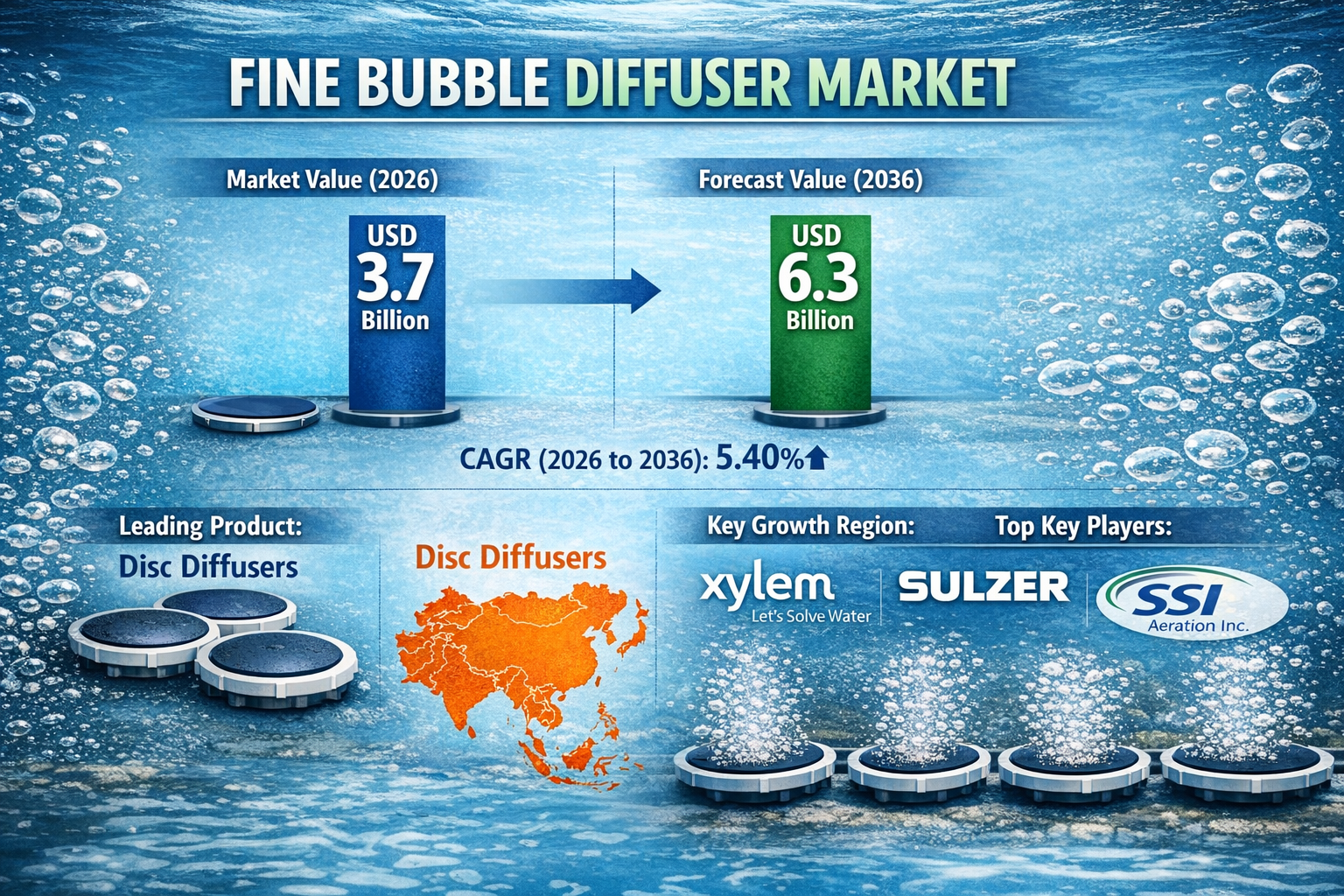
NEWARK, DE, UNITED STATES, February 20, 2026 /EINPresswire.com/ -- The global fine bubble diffuser market is projected to reach USD 3.7 billion in 2026 and expand to USD 6.3 billion by 2036, growing at a CAGR of 5.40%. The market’s steady trajectory reflects increasing investments in wastewater treatment infrastructure, stricter environmental discharge norms, and growing emphasis on energy-efficient aeration technologies.
Procurement behavior across municipal and industrial utilities is evolving. Buyers are prioritizing long-term operational stability, regulatory compliance, and measurable energy savings over short-term capital cost advantages. Vendor credibility, technical service support, and lifecycle performance data have become central to procurement decisions.
Fine bubble diffusers are critical to biological wastewater treatment processes. By producing smaller, uniformly distributed bubbles, these systems significantly enhance oxygen transfer efficiency, improving microbial digestion of organic matter while lowering energy consumption compared to coarse bubble systems.
Request For Sample Report | Customize Report | Purchase Full Report - https://www.futuremarketinsights.com/reports/sample/rep-gb-19296
Market Snapshot
• Market Value (2026): USD 3.7 Billion
• Forecast Value (2036): USD 6.3 Billion
• CAGR (2026–2036): 5.40%
• Leading Product Segment: Disc Diffusers (48.70% share)
• Dominant Application: Municipal Wastewater Treatment (56.40% share)
• Fastest Growing Region: Asia Pacific
Procurement Trends and Buyer Dynamics
Infrastructure longevity is shaping supplier relationships. Wastewater treatment facilities operate on multi-decade lifecycles, which increases switching costs and reinforces vendor lock-in. Replacing aeration systems often involves operational downtime, capital-intensive retrofitting, and regulatory revalidation.
As a result, buyers prefer established manufacturers offering:
• Proven oxygen transfer performance
• Long membrane durability
• Integrated monitoring compatibility
• After-sales maintenance and technical support
Risk aversion among procurement teams has intensified, particularly in regions with tightening effluent discharge regulations.
Disc Diffusers Lead Product Segment
Disc diffusers command 48.70% of total market share. Their dominance stems from compact design, high oxygen transfer rates, and ease of installation. These systems are particularly suited for large-scale municipal wastewater facilities where uniform aeration and airflow control are critical.
The design flexibility of disc diffusers enables efficient handling of varying air volumes while maintaining stable bubble distribution. Energy optimization has further strengthened their adoption in retrofit and new-build treatment plants.
Tube and plate diffusers continue to serve niche industrial applications, but disc variants remain the preferred option for scalable municipal deployments.
Municipal Wastewater Drives Demand
Municipal wastewater treatment accounts for 56.40% of total application share, making it the backbone of market expansion. Rapid urbanization, rising sewage generation, and regulatory mandates for nutrient removal are driving upgrades of aging treatment infrastructure.
Fine bubble diffusers support:
• Enhanced nitrogen and organic load removal
• Reduced aeration energy costs
• Improved compliance with discharge standards
Governments across emerging economies are expanding wastewater treatment capacity to meet environmental targets, further reinforcing steady market demand.
Regional Outlook: Asia Pacific at the Forefront
Asia Pacific remains the fastest-growing region, driven by infrastructure modernization and industrial expansion.
Country-Level CAGR (2026–2036):
• India – 6.1%
• China – 5.4%
• Indonesia – 5.2%
• USA – 5.1%
• Brazil – 4.9%
India leads growth as urban wastewater generation rises alongside national initiatives to strengthen sewage treatment capacity. China continues to invest heavily in industrial wastewater management, particularly across textiles, chemicals, and food processing industries.
In Southeast Asia, industrialization and stricter environmental frameworks are accelerating adoption of energy-efficient aeration technologies. Meanwhile, the United States and Brazil are witnessing modernization-driven upgrades to existing treatment plants, focusing on operational efficiency and compliance.
Technology and Innovation Trends
Innovation in membrane materials such as EPDM, silicone, and ceramic composites is enhancing diffuser durability and fouling resistance. Manufacturers are focusing on modular designs that allow phased plant expansion and simplified maintenance.
Integration with digital monitoring systems is gaining traction. Real-time performance tracking, predictive maintenance alerts, and airflow optimization are enabling wastewater operators to reduce downtime and energy consumption.
Sustainability considerations are also reshaping procurement criteria. Utilities are prioritizing systems that reduce carbon footprint and electricity demand, positioning fine bubble diffusers as a preferred aeration solution.
Competitive Landscape
Competition centers on oxygen transfer efficiency, durability, and system integration capabilities.
Key players include:
• Xylem Inc.
• Sulzer
• SSI Aeration Inc.
• Jäger Umwelt-Technik
• Aqua-Aerobic Systems
• Environmental Dynamics International
• Aquaconsult Anlagenbau
• Refractron Technologies
• OTT Group
• Diffused Gas Technologies
Market leaders emphasize long-term reliability, optimized airflow distribution, and compatibility with advanced wastewater control systems. Companies are also strengthening regional distribution networks to secure municipal contracts and infrastructure tenders.
Outlook
With global wastewater volumes rising and environmental compliance thresholds tightening, the fine bubble diffuser market is positioned for sustained growth through 2036. Energy-efficient aeration solutions are becoming a strategic investment rather than an operational expense, reshaping procurement strategies worldwide.
As municipalities and industrial operators prioritize lifecycle cost optimization and environmental stewardship, fine bubble diffuser systems will remain central to next-generation wastewater infrastructure.
Browse Related Insights
Diffuser Membrane Market: https://www.futuremarketinsights.com/reports/diffuser-membrane-market
Heat Diffuser Market: https://www.futuremarketinsights.com/reports/heat-diffuser-market
Demand for Diffuser Membrane in USA: https://www.futuremarketinsights.com/reports/united-state-diffuser-membrane-market
About Future Market Insights (FMI)
Future Market Insights, Inc. (FMI) is an ESOMAR-certified, ISO 9001:2015 market research and consulting organization, trusted by Fortune 500 clients and global enterprises. With operations in the U.S., UK, India, and Dubai, FMI provides data-backed insights and strategic intelligence across 30+ industries and 1200 markets worldwide.
Sudip Saha
Future Market Insights Inc.
+ +1 347-918-3531
email us here
Legal Disclaimer:
EIN Presswire provides this news content "as is" without warranty of any kind. We do not accept any responsibility or liability for the accuracy, content, images, videos, licenses, completeness, legality, or reliability of the information contained in this article. If you have any complaints or copyright issues related to this article, kindly contact the author above.
